In Part 1, we said no single food is good or bad on its own. In Part 2, we saw that the eating patterns that work share the same foundation. Now we're zooming in on each part of the plate, starting with the one everyone loves to blame: carbs.
Pretty much all my clients are missing one essential nutrient. Believe it or not, it's a type of carbohydrate, and most of us aren't getting nearly enough of it.
Many of my clients come to me thinking carbs are automatically the bad guy. Eat pasta, bread, or a plate of rice, and you're guaranteed to gain weight, and there's not much you can do about it. But carbohydrates play a really important role in our lives. And one kind in particular can be a key to weight loss, steadier energy, and a long list of other health benefits.
I've seen it time and time again: when people add this nutrient to their plates, their energy, their digestion, and even their lab results often improve. I'm talking, of course, about fiber.
Fiber is one of the most neglected nutrients out there. Only about 1 in 20 Americans eats enough of it [1]. So if fiber is a carbohydrate (it is!), why have carbs gotten such a bad reputation? To answer that, I need to put my chemist hat back on for a few minutes.
Carbs aren't one thing. They're a family.
The more I learned about nutrition, the more I realized how deeply chemistry is involved. At the end of the day, carbohydrates, fats, and proteins are all chemicals. More specifically, they're families of chemicals, not single chemicals.
The carbohydrate family contains a huge number of different molecules. But they're all built from the same kind of building block: small sugar units. The two you'll hear about most are glucose and fructose. Both are small molecules made of carbon, hydrogen, and oxygen, curled up into rings. That's why we draw glucose as a hexagon and fructose as a pentagon in the diagrams below.
You might be thinking, “Oh my gosh, this is getting worse before it gets better.” Because yes, I'm telling you that every carbohydrate is made of sugar units. Stay with me. That's exactly why the details matter.
Those sugar units can show up on their own, in pairs, or in long chains. And the way they're linked together decides a lot about what they do in your body.
Singles and pairs. A single sugar unit, like the fructose in fruit and honey, is the simplest kind of carbohydrate. When we say “sugar” in everyday life, we usually mean table sugar, which is a pair: one glucose and one fructose, joined by one specific link.
Chains. Link lots of glucose units together and you get starch, the main carbohydrate in rice, bread, and starchy staples like yams and plantains. Starch chains can be straight or branched, and one starch molecule can hold thousands of glucose units.
The link that changes everything. This is my favorite part. Every link between sugar units has its own shape, and that shape decides whether our digestive enzymes can break it. Cellulose, a type of fiber found in the walls of plant cells, is also a long chain of glucose. Same building blocks as starch! The only difference is how the glucose units are linked to each other.
That one small difference matters a lot. Your digestive enzymes (proteins that cut big molecules into smaller ones) work like tiny scissors. They fit the links in starch perfectly, so they snip starch into single glucose molecules that pass into your blood. But they can't cut the links in cellulose. Same building blocks, different link, completely different job in your body.
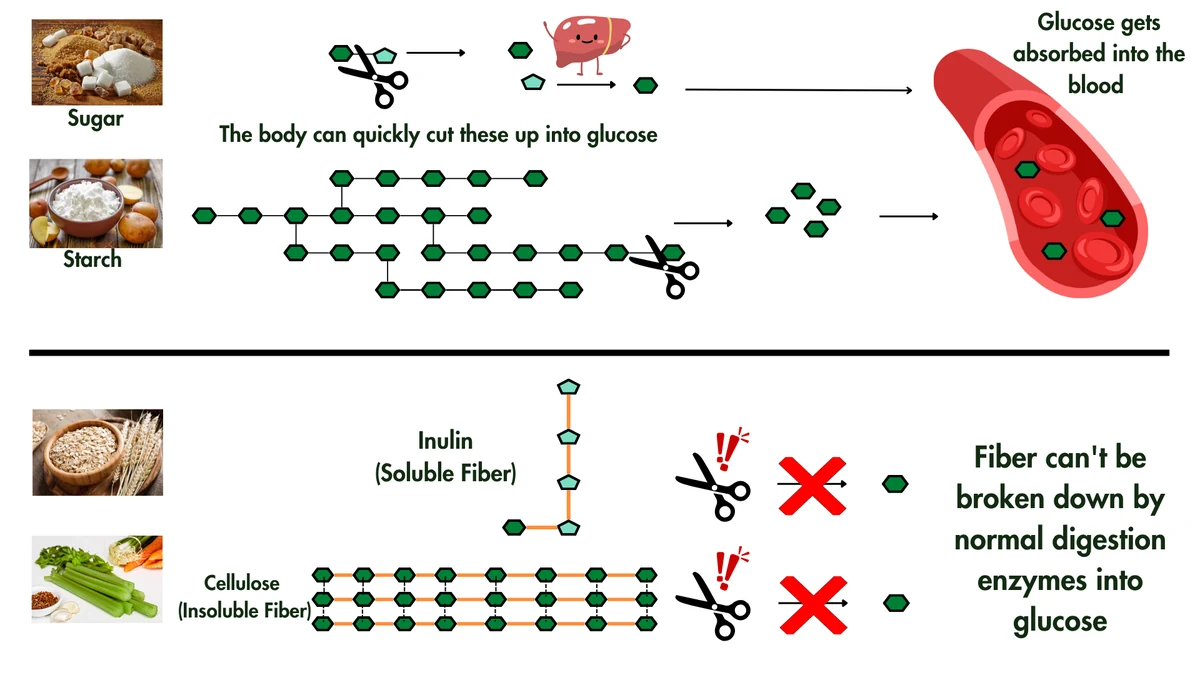
Not every fiber is made of glucose. Inulin, for example, is a chain of fructose units. But all fibers share that key feature: our scissors can't cut them.
So instead of sorting carbs into “good” and “bad,” picture them on one line, sorted by how fast your body can turn them into blood glucose:
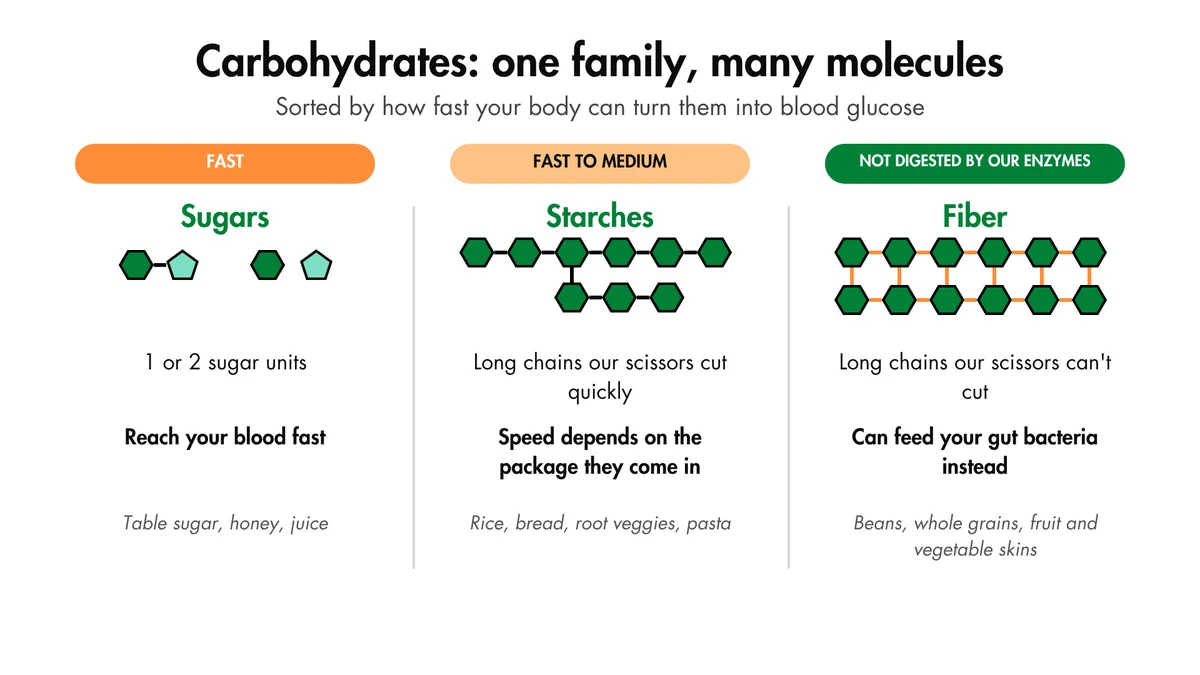
You may have heard carbs split into “simple” and “complex.” Starch is technically a complex carb, since it's a long chain. But our scissors cut it so fast that refined starch, like white bread, behaves a lot like sugar. So chain length isn't what matters most. What matters is how fast the carb reaches your blood, and the links and the package it comes in decide most of that.
What carbs do for you
You might be thinking, “Okay, so carbohydrates are basically sugar in different outfits. How is that not bad for me?” Again, we have to go back to context. What are these molecules doing in our bodies? What is their job, and how can we use them wisely?
Our bodies run on glucose. You may have heard that people with diabetes worry about having too much glucose in their blood. That's true. But it doesn't mean the healthy amount of glucose in your blood is zero. You always need some, because glucose is your body's go-to quick fuel and your brain's favorite. Your red blood cells run on glucose alone, and your muscles reach for it whenever you push harder. The Recommended Dietary Allowance (the official daily target) for carbohydrate is 130 grams for most adults, based mainly on what your brain needs [2].
Your body can make glucose in other ways, too. It can build new glucose from protein and from a small piece of each fat molecule, and on very low-carb diets the brain switches partly to ketones, a backup fuel the liver makes from fat. That's how many of our keto and carnivore friends get by, and we talked about what that switch can feel like in Part 2. But it isn't the body's default setting. When we eat carbohydrates, they give us glucose in a ready-to-use form, and that's what keeps us going through the day.
That's why most people's diets tend to be higher in carbohydrates than anything else. Guidelines suggest that 45 to 65% of your calories come from carbs [2], and many traditional and plant-based ways of eating run even higher and do well. I often think of it this way: you need to get the right amounts of protein and fat for your body, and the rest tends to be carbohydrates.
The research backs up the positive side, too. In a study that followed about 47,500 women for decades, the ones who ate more carbohydrates, especially high-quality carbs from whole grains, fruits, vegetables, and beans, were more likely to reach older age healthy: free of major chronic disease, with good memory, strength, and mental health. Refined carbs went the other way [3].
So why do carbs get such a bad rap?
If carbs are our main fuel, why do so many people get in trouble with them, especially if they have diabetes or prediabetes or are trying to lose weight? It depends on the type of carbohydrate and how you're eating it. And mostly, it comes down to speed.
Sugars and refined starches are processed very quickly. Suddenly your body gets a rush of glucose molecules into your blood. That rush can power your body fast, which is exactly what you want sometimes. Athletes in the middle of a long race need that energy right away. And if you have diabetes and your blood sugar drops too low, a quick carb like juice or a piece of candy does a great job of bringing it back up. (If that's you, follow the plan your doctor gave you for lows.)
But if you're sitting at a computer most of the day, that rush is often more glucose than you need right then. Your body responds by releasing insulin, the hormone that helps move glucose out of your blood and into your cells. Some of that glucose gets used right away, and some gets stored as glycogen (a stored form of glucose in your muscles and liver) for later. That part is normal and healthy. But when big rushes come again and again and those stores are already full, your body tucks the extra energy away as fat.
Many people also notice the other side of the rush. A couple of hours after a meal heavy in refined carbs, they feel tired, foggy, and hungry again.
So carbs themselves aren't the problem. It's an imbalance in how fast those carbs are released versus how soon you need their energy. And this is where fiber comes in.
Fiber: the brake pedal
Remember, fiber is the carb our scissors can't cut. It doesn't get broken down into glucose like starch does. So when fiber comes along in a meal, it adds bulk and slows down the digestion of the other carbohydrates on the plate.
Fiber, especially the gel-forming kind, works like a brake. It lets the glucose from your meal enter your bloodstream at a slower pace. You'll still get a rise in blood glucose, but often a gentler one, with a smaller insulin peak. That can spread your energy out over more of the day instead of having it arrive all at once.
Fibers are generally divided into two classes. Soluble fiber dissolves in water, and many types form a gel, like the gel in cooked oatmeal. That gel does a lot of the slowing down. Insoluble fiber doesn't dissolve. It adds bulk and keeps things moving through your digestive system. The two work as a team in your gut.
So where does fiber go if we can't digest it? It travels down to your large intestine, where your gut microbiome, the trillions of beneficial bacteria that live in your gut, takes over. They ferment many kinds of fiber into short-chain fatty acids, small molecules that do good work for you (more on that in a minute). Basically, when you eat fiber, you're feeding your microbes, and they pay you back. It's a win-win!
What fiber does for you
Digestion
Insoluble fiber keeps things moving, and soluble fiber holds onto water, which can soften hard stools and firm up loose ones. Together, they can help with both constipation and diarrhea, especially when you're drinking enough water.
Fullness and steadier blood sugar
Fiber slows digestion, and fiber-rich foods tend to be bigger and more filling for the same calories. There may be some chemistry at work here, too. When gut bacteria ferment fiber, the short-chain fatty acids they make can signal your gut to release its own fullness hormones, GLP-1 and PYY [4]. So fiber may nudge the same fullness signal that drugs like Ozempic copy at much higher doses. That fullness is what surprises my clients most. Many have tried diet after diet and always felt hungry, but once their meals are built around fiber, they can't believe how much more they get to eat.
Heart health
Soluble fiber traps bile acids, which your liver makes from cholesterol. To make new bile acids, your liver pulls more cholesterol out of your blood, including LDL, the kind that can build up in the arteries.
Liver health
Fatty liver is when fat builds up in the liver because of metabolic problems like insulin resistance, not alcohol. (Doctors now call it MASLD [5].) In a UK study of about 190,000 adults followed for about 10 years, the people who ate the most fiber had about 28% lower risk of fatty liver and less liver fat on MRI scans [6]. A study like that shows a link, not proof that fiber alone made the difference, but I've seen it play out with my own clients. Some came to me with elevated liver enzymes and doctors worried about fatty liver. We added fiber bit by bit, along with exercise and other lifestyle changes, and by the time we finished working together, their liver enzymes were back in a healthy range. Everyone's body is different, but those were exciting results to see.
Your gut microbiome
Remember those short-chain fatty acids? One of them, butyrate, is a favorite fuel for the cells lining your colon [7]. Lab and animal studies suggest butyrate also helps those cells keep your gut lining strong and sealed [8]. Feed your microbes well, and they help take care of you.
Long-term health
In a large review of studies from around the world, people who ate the most fiber had 15 to 30% lower rates of heart disease, stroke, type 2 diabetes, colorectal cancer, and early death. The biggest benefits showed up at 25 to 29 grams a day, and more may be even better [9].
Same carbs, different package
Practically, what does all this mean for us? The carbs that do you the most good are the ones that come in their whole-food package, with their fiber, vitamins, and minerals still attached.
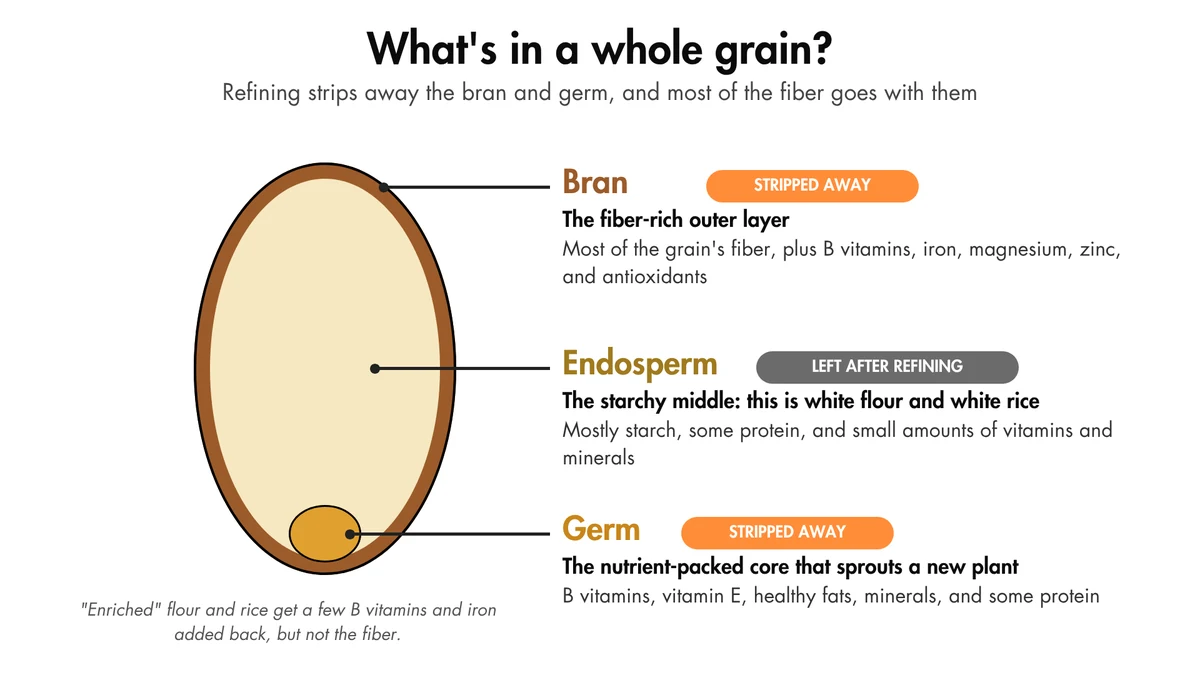
Take a grain of rice or wheat. A whole grain keeps all three parts of the kernel: the bran (the fiber-rich outer layer), the germ (the nutrient-rich core), and the endosperm (the starchy middle). Refining strips away the bran and the germ, and most of the fiber goes with them, along with many of the vitamins and minerals. What's left is mostly starch: quick calories that don't give you long, steady energy or the other benefits fiber brings. For example, one cup of cooked white rice has about 0.6 grams of fiber. Brown rice has about 3.2 grams [10].
A big new review of 87 randomized trials, with about 6,500 adults, put whole grains to the test. Eating more whole grain lowered LDL cholesterol, triglycerides (a type of fat in the blood), and blood pressure, and on average, weight dipped slightly [11]. The benefits started at about 2 servings a day and were biggest at about 4 to 6 servings. One serving is about ½ cup of cooked oatmeal or brown rice, or 1 slice of 100% whole-wheat bread.
One word of caution: food companies want to cash in on the whole-grain trend. Sometimes a package says “whole grain” and the fiber is still lacking. A cookie with “whole grain” on the box isn't the same as a bowl of oatmeal. Check the Nutrition Facts label for dietary fiber. A food with 10% or more of the Daily Value (about 3 grams per serving) is a decent source, and 20% or more (about 5.6 grams) is high.
How much fiber do you need?
| Who | Fiber per day | Source |
|---|---|---|
| Women 19 to 50 | 25 g | National Academies [2] |
| Men 19 to 50 | 38 g | National Academies [2] |
| Women 51+ | 21 g | National Academies [2] |
| Men 51+ | 30 g | National Academies [2] |
| Any adult | at least 25 g, from food | WHO [12] |
| Kids 2 to 5 / 6 to 9 / 10+ | at least 15 / 21 / 25 g | WHO [12] |
Those are the standard targets, but in our experience, more can be better for some goals. When Dr. Giomarell was at Loma Linda University, he coached a group in the Full Plate Diet, a lifestyle program that aims for about 40 grams of fiber a day. He saw firsthand that the people who pushed their fiber to that higher level tended to get the best results. A larger analysis of more than 4,400 people in the same program (now called Full Plate Living) found a similar pattern: those who added the most fiber-rich foods, especially fruits and vegetables, tended to lose the most weight [13]. That fits with the bigger research picture, where benefits keep showing up past the minimum [9].
Other research points the same way. In a year-long trial, people with metabolic syndrome who were given one simple goal, eat 30 grams of fiber a day, lost almost as much weight as people given a full, more complicated heart-healthy diet [14]. And in another large weight-loss study, fiber intake was the strongest predictor of how much weight people lost and whether they stuck with their diet [15]. Everyone's body responds differently, and fiber isn't a magic fix. But if you're working on weight loss, it's one of the simplest, most satisfying places to start.
Where to find fiber
Where can you find fiber? The great news is that delicious sources of it are almost everywhere. You don't need a fiber supplement, and you don't have to depend on bland cereals that say they're full of fiber. Foods with added fibers can be good tools, but for most of my clients, what works best is adding foods that naturally contain a lot of fiber.
Thankfully, here in Puerto Rico (and pretty much anywhere in the world) we're surrounded by them.
Beans are the hero. The humble bean is a wonderful package of fiber. A ½ cup adds 4.5 to 7.5 grams, depending on the bean, and a full cup of black beans gets most women more than halfway to their daily goal. So a bigger scoop of beans next to your rice is a great place to start. Even better, our culture already gives us the habit: adults in Puerto Rico who enjoy beans and feel family and cultural support for eating them eat more of them [16].
Keep your rice, and let the fiber travel with it. You don't have to give up your rice. How much and what it comes with matter. Large studies have linked swapping even a third of a serving of white rice a day for brown rice with about 16% lower diabetes risk [17]. A few moves that work:
- Mix brown rice into your white rice. Start with about one-quarter brown and work up.
- Keep the bean portion generous.
- Add avocado on the side.
Starchy staples and fruit. Yams, sweet potatoes, and green plantains, along with tropical fruits like guava, bring fiber along with their starch and natural sugars. That's the whole-food package at work.
Sprinkle on some seeds. Chia and flax seeds are two of the most concentrated fiber sources you can find, and they're easy to add to food you already eat. One tablespoon of chia has about 4 grams of fiber, and one tablespoon of ground flaxseed has about 2 [10]. Stir them into oatmeal, yogurt, or a smoothie, or sprinkle them over a salad. Chia seeds are best soaked, and grind flax before you eat it, because whole flaxseeds can pass through without your body getting much from them.
| Food | Portion | Fiber (g) |
|---|---|---|
| Lentils, cooked | ½ cup | 7.8 |
| Black beans, cooked | ½ cup | 7.5 |
| Red kidney beans, cooked | ½ cup | 6.5 |
| Chickpeas, cooked | ½ cup | 6.2 |
| Pigeon peas (dried), cooked | ½ cup | 5.6 |
| Breadfruit, raw | 1 cup | 10.8 |
| Raspberries | 1 cup | 8.0 |
| Pear | 1 medium | 5.5 |
| Yam, boiled | 1 cup | 5.3 |
| Avocado (Florida type) | ¼ fruit | 4.3 |
| Chia seeds | 1 Tbsp | about 4 |
| Oats, uncooked | ½ cup | 4.1 |
| Sweet potato, boiled | 1 medium | 3.8 |
| Green plantain, boiled | 1 cup | 3.6 |
| Brown rice, cooked | 1 cup | 3.2 |
| Banana | 1 medium | 3.1 |
| Guava | 1 fruit | 3.0 |
| Broccoli, boiled | ½ cup | 2.6 |
| Ground flaxseed | 1 Tbsp | 1.9 |
| White rice, cooked | 1 cup | 0.6 |
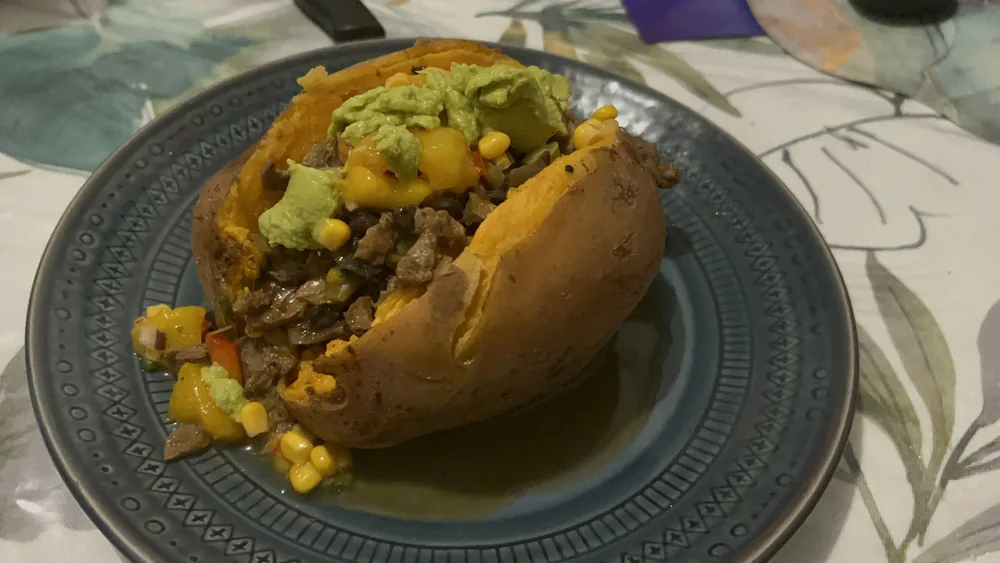
Here's a meal I shared during our Cooking in Community challenge. Steam a sweet potato until it's fork-tender, split it open, and top it with seasoned TVP (textured vegetable protein, a dried soy product that cooks up a lot like ground meat), a fresh mango salsa, and sliced avocado. One bowl has roughly 12 to 13 grams of fiber and about 15 grams of protein, so it's a complete, filling meal and not only a side. It's also a really flexible recipe, so swap in the toppings you love or already have on hand. Email subscribers can get my hummus-topped version, plus the recipe for that mango salsa, in That Clean Life.
Start slow (your gut will thank you)
You may have seen “fibermaxxing” on social media, where people compete to pack as much fiber as possible into their day. I love that fiber is finally getting attention! But the goal is to reach your target and build up to it gradually, not to blow past it overnight. Some influencers push 50 to 70 grams or more, and dietitians warn that going very high too quickly can cause bloating and may get in the way of absorbing some minerals [18].
If you jump from very little fiber, which is where most of us are, to 40 or 50 grams overnight, your body won't be ready. Remember, fiber travels on to your gut microbiome. If you're starting out, your gut bacteria probably aren't used to that much fiber yet. Give them a lot all at once, and they can't keep up, which can mean gas, bloating, and an unhappy belly.
If that happens at first, it's completely normal. Here's how I like to start:
- Week 1: Add a good fiber source to your breakfast.
- Week 2: Once that feels fine, add one to your lunch.
- Week 3: Add one to your dinner.
- Keep going from there until you reach your target, at whatever pace feels good for your body.
Drink more water as your fiber goes up, since fiber works best with water. And if you have a bowel condition or have had intestinal surgery, talk with your doctor before making big changes.
Putting it on your plate
You don't have to be scared of carbohydrates. You need to understand them. They're a big family of molecules, from quick sugars all the way to fiber, and context matters. Sometimes there's a time and a place for a fast carb, like after a lot of exercise or during a low blood sugar. But for most of us, day to day, we'd do better with more carbs that come in their whole-food package.
When carbs come with their fiber still attached, in a bowl of oatmeal, a plate of beans, or a slice of breadfruit, they're some of the best things you can put on your plate. Start with one swap this week, and let your gut catch up.
Coming up next in Back to the Plate: In two weeks, we'll turn to protein: how much you really need, where it comes from, and why a molecule called leucine got this chemist so excited.
The best way to catch every post in the series is to join our newsletter. You'll get each new post in your inbox, plus the recipes, myth-busts, and little check-ins we share in between.
You don't have to figure it all out alone. We're here to help!