
A fall series on the science of eating well, one piece at a time. New posts every two weeks through December.
“Doctor, which diet should I be on?”
I hear this question almost every week. Sometimes it comes at the very end of a visit, with one hand already on the door. Sometimes it comes with a whole list. “I tried keto, but I missed my rice too much. Then I did intermittent fasting, but by lunchtime I was so hungry I couldn't think. My cousin went carnivore and says he feels amazing. And my sister-in-law sent me a video that says vegan is the only healthy way to eat… so which one is right?”
Then they look at me, waiting for the answer. And I understand why. There is so much noise out there, and every diet seems to come with someone online promising that this one is the one.
So let's think for a moment, together. Is there one best diet? And do you even need one?
Two weeks ago, Chelsea asked you whether a little red Mini Cooper was a good car… and you knew the answer before she finished asking. It depends! The same turned out to be true for a cookie. A food can't be good or bad on its own. It depends on its job, your needs, and what else is on your plate.
So today, let's make that question a little bigger. If a single food can't be good or bad… what about a whole diet?
Going on a diet, or living your diet?
What comes to your mind when you hear the word “diet”?
For most of us, it's a set of rules. No carbs after six. No bread. Only shakes until Friday. It's something you start on a Monday (it's always a Monday!) and stop a few weeks later, when life gets busy, or a birthday party comes around, or you just get tired of fighting. If you've been there, you're not alone. Most of us have.
And that start-and-stop cycle tends to backfire, because after a crash diet, the body pushes back. In one study, people lost about 30 pounds on a strict 10-week diet. A full year later, their hunger hormones still hadn't gone back to normal, and they felt hungrier than they did before they started. [1] It isn't a lack of willpower. It's biology. (Chelsea dug into this in a recent newsletter, too.)
But the word “diet” has another meaning, and it's a much older one. It comes from the Greek diaita, which means “way of life.” It was never meant to be a punishment or a 30-day challenge. It's just… the way you live and eat, every day, for years.
That's the kind of diet I want to talk about today. Not a quick fix, or a temporary solution, or a random list of rules you're always fighting against. A way of eating you actually enjoy, and can keep enjoying.
Your diet isn't something you go on. It's how you live.
What does the label really tell you?
So how do we know if a way of eating is a good one? A lot of people start with the label.
When patients ask me about plant-based diets, it's common to see confusion on their faces. Are Frosted Flakes plant-based? Technically, yes. Soda? Surprisingly, also yes. Many processed-food companies will gladly put “plant-based” on their packaging to attract people. But if that's the case, does “plant-based” actually mean anything useful for your health?
There are a lot of labels out there for how you choose to eat. Most people are omnivores who eat some of everything: meat, fish, eggs, dairy, and plants. Others leave out some or all animal products and focus on plants. Within plant-based eating, there are even more variations. You might have heard terms like vegetarian, lacto-ovo vegetarian, pescatarian, or vegan. I've personally explored these ways of eating at various times. And keto, paleo, and carnivore work the same way, just from the other direction.
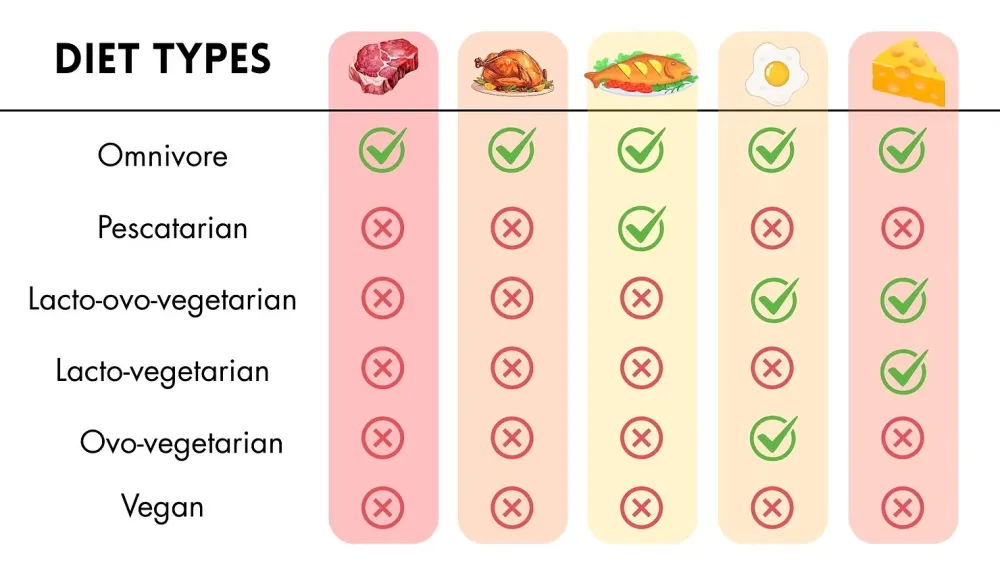
However, there is one major issue with all these labels. They focus on what they leave out, not what they add in.
Removing groups of food doesn't automatically make a diet health promoting, especially if the rest of the plate is ultra-processed foods, or foods high in salt, sugar, and fat. So instead of asking what a diet takes away, let's ask what it includes.
What do good diets have in common?
This is where the science gets really encouraging.
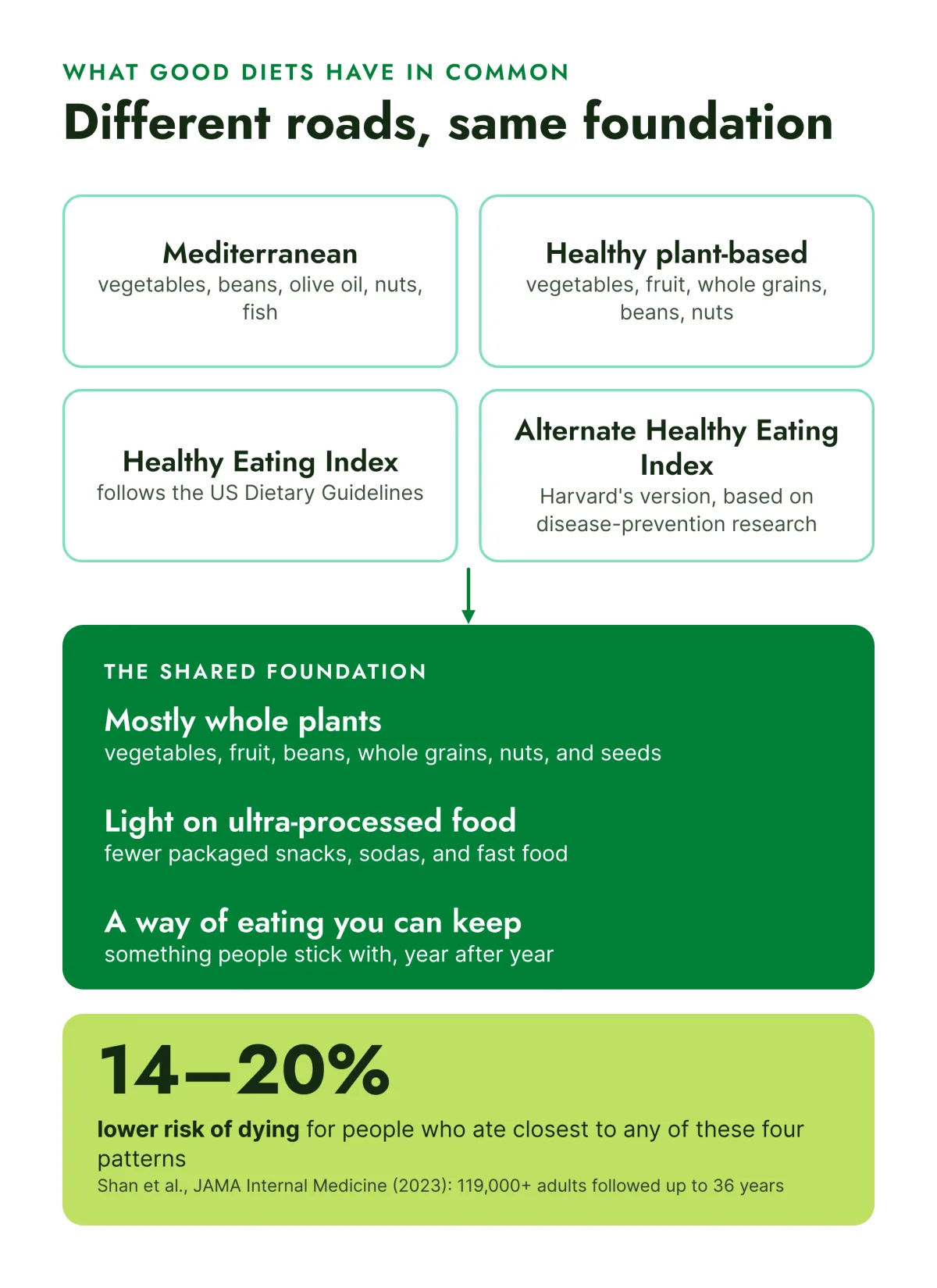
Let me share one of my favorite studies. Researchers followed more than 119,000 adults for up to 36 years and scored how closely each person's eating matched four different healthy patterns: the Mediterranean diet, a healthy plant-based pattern, and two healthy-eating scores, one based on the US Dietary Guidelines and one built by Harvard researchers around foods linked to lower risk of chronic disease. People who matched any of the four most closely had a 14 to 20% lower risk of dying during the study than people who matched least. And the link held for Hispanic, Black, and White participants alike. [2] The researchers' conclusion? Healthy eating patterns can be adapted to individual food traditions and preferences.
Four different patterns, and very similar results. Why?
Because when you look underneath the names, the patterns that work share the same foundation. They're built mostly on whole plants, like vegetables and fruit, beans and lentils, whole grains, nuts, and seeds. They go light on ultra-processed foods. And they're something people can keep doing, year after year.
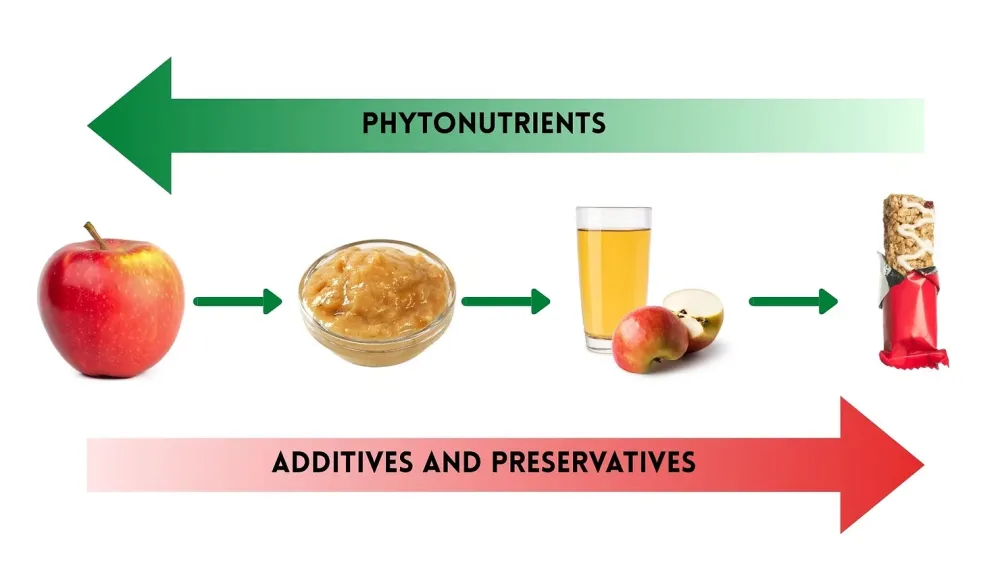
Why does processing matter so much? Let's take a familiar example: the apple.
A whole apple, crisp, fresh, and eaten with the skin, gives you fiber, water, natural sugars, vitamins, and phytochemicals that protect and nourish your cells. Turn that apple into applesauce, and you've already broken down some of the fiber. Juice that same apple, and now you've removed nearly all the fiber. Take it one step further and turn that apple into a shelf-stable snack bar… it may taste like apple, but nutritionally, it's far removed from the fruit you started with.
And it isn't only about the nutrients we lose. Processing also changes how much we eat. In a careful study at the National Institutes of Health, 20 adults stayed at the research center for four weeks. For two weeks they ate ultra-processed meals, and for two weeks they ate minimally processed meals. On paper, the menus were matched for calories, sugar, fat, fiber, and salt, and people could eat as much or as little as they wanted. On the ultra-processed menu, they ate about 500 more calories a day and gained about 2 pounds in two weeks. [3] It was a small, short study, but it shows something important: the same numbers on a label don't act the same way in your body.
We also have strong clinical trials showing what these patterns can do.
In the DASH trial, 459 adults ate a diet rich in fruits, vegetables, and low-fat dairy, with less saturated fat. In just 8 weeks, their blood pressure came down. For people who already had high blood pressure, the top number dropped by about 11 points, and that was without losing weight. [4]
In Spain, the PREDIMED trial followed 7,447 adults at high risk of heart disease. The groups who ate a Mediterranean diet with extra olive oil or nuts had about 30% fewer heart attacks, strokes, and heart-related deaths than a group told to eat a lower-fat diet. [5]
And in the DIETFITS trial, 609 adults followed either a healthy low-fat diet or a healthy low-carb diet for a full year. Both groups were coached to eat plenty of vegetables, choose whole foods, and cut back on added sugar and refined flour. After a year, they lost about the same amount of weight, around 12 to 13 pounds. [6] Low-fat or low-carb, the label mattered less than the quality of the food.
There's even more than one way to eat well within plant-based eating. The Adventist Health Study 2 is close to my heart, because it comes from Loma Linda University, where I did my public health training. It followed more than 73,000 Adventists in the US and Canada. Vegetarians overall had about a 12% lower risk of dying during the study than non-vegetarians, and the lowest risk was in pesco-vegetarians, people who eat fish along with their plant foods. [7] This was an observational study, so it shows a link, not cause and effect. But it's one more reminder that the healthiest plate doesn't come in only one shape.
eaten on ultra-processed meals that matched the other menu on paper [3]
drop in systolic blood pressure (the top number) on DASH in 8 weeks, for people with high blood pressure [4]
fewer heart attacks, strokes, and heart-related deaths on a Mediterranean diet with olive oil or nuts [5]
healthy low-fat or healthy low-carb, after a full year [6]
What about the diets you keep hearing about?
So the name on a diet matters less than what's underneath it. With that in mind, let's take a quick tour of the diets that show up in the news, and in our patients' questions. For each one, I'll share what it gets right and where I see people get stuck. Not to judge anyone's choices… but to help you see each one a little more clearly.
Mediterranean
What it gets right: vegetables, beans, whole grains, olive oil, nuts, and fish, often eaten slowly at a table with family and friends. It has some of the strongest evidence we have. [2, 5] Where people get stuck: the marketing. A “Mediterranean” label on a frozen pizza doesn't make it Mediterranean, and a glass of red wine isn't a health food.
DASH
What it gets right: it was designed to lower blood pressure, and it works fast. [4] Where people get stuck: it isn't trendy. It doesn't have a big social media following, so a lot of people have never heard of it.
Plant-based, vegetarian, and vegan
What they get right: lots of fiber, lots of whole plants, and strong long-term data. [7] This is how Chelsea and I eat, and I'll tell you more about why below. Where people get stuck: plant-based junk food (remember the Frosted Flakes?), and nutrients that need some planning, like vitamin B12.
What surprises a lot of people is that most of the patients I see with low B12 aren't vegans at all. They eat meat! Many of them are middle-aged, not diabetic, and not taking any medicine known to lower B12. The research backs this up. In the Framingham Offspring Study, researchers measured B12 in about 3,000 adults ages 26 to 83. Nearly 4 in 10 had levels in the low-to-borderline range, and it was about as common in adults under 50 as in those over 65. Eating more meat made surprisingly little difference. The people with the best levels were the ones who took a supplement or regularly ate fortified cereal or dairy. [8]
Age and medicines do add to the risk. As we get older, our stomachs make less of the acid we need to absorb B12 from food, and some common medicines, like metformin or long-term acid reducers, can lower it too. [9, 10] In large surveys, about 6% of adults over 60 are deficient in B12, and close to 20% are borderline. [9] So checking your levels, and taking a supplement when you need one, isn't just a vegan thing. We'll talk more about vitamins and minerals later in this series.
Keto and low-carb
What they get right: they cut way back on added sugar and refined flour, and when food quality is high, low-carb can work for weight loss as well as low-fat. [6] Where people get stuck: they're hard to keep up, and when beans, fruit, and whole grains leave the plate, fiber leaves with them. In one small inpatient study, people ate about 550 to 690 fewer calories a day on a plant-based, low-fat diet than on an animal-based keto diet. [11] It was only 20 people for two weeks on each diet, but it's interesting.
Keto can also come with some surprises in the first few weeks. I still remember a patient at Loma Linda who came to our preventive care office after two months of keto. He had lost some weight, but he told me his mind felt foggy. Both things make sense. When you cut carbs, your body first burns through its stored carbohydrate, called glycogen, and every gram of glycogen is stored with about three to four grams of water. [12] So the first few pounds that come off fast are mostly water, not fat. In one careful study, men lived at a research center so every bite could be measured. When they switched to a keto diet with the same number of calories, their fat loss actually slowed down. [13] And the fog? Your brain normally runs on glucose. It can learn to use ketones (a fuel your liver makes from fat) instead [14], but that switch takes time. In small studies, people did worse on some memory and mental-flexibility tests during the first week of a very low-carb diet. [15, 16] Online, people call it the “keto flu”: headache, fatigue, and brain fog, usually worst in the first week or two and fading after about a month. [17] If the fog sticks around longer, like it did for my patient, that's worth a conversation with your doctor.
Paleo
What it gets right: it cuts out most ultra-processed food and puts more vegetables, fruit, and nuts on the plate. In a handful of short trials, people with metabolic risk factors saw small improvements in waist size, triglycerides, and blood pressure compared with standard diets. [18] Where people get stuck: those were only four trials with 159 people, for six months or less. And paleo leaves out beans and whole grains, two of the foods with the strongest evidence behind them. (No arroz con habichuelas? That's a hard sell in Puerto Rico.)
Intermittent fasting
What it gets right: it's simple. Some people find that a shorter eating window helps them stop late-night snacking or mindless grazing. But there's nothing magical about the hours. In a yearlong trial, 139 adults all ate the same reduced number of calories, and half of them ate only between 8 a.m. and 4 p.m. Both groups lost about the same amount of weight. [19] In another trial, eating only from noon to 8 p.m., with no other changes, didn't lead to more weight loss than eating three regular meals. [20] So when intermittent fasting works, it's mostly because a shorter window makes it easier to eat less. Where people get stuck: it says nothing about what you eat. A low-quality diet squeezed into fewer hours is still low quality, and it can make it even harder to get the nutrients you need. And for some people, long stretches of hunger end in a big binge later. If that's you, it isn't a willpower problem. It's just not your tool.
Carnivore
What it gets right: people in a large survey of more than 2,000 carnivore eaters said they felt better and lost weight, and many of them had probably cut out a lot of ultra-processed food and sugar along the way. Where people get stuck: among those who shared their lab results, LDL cholesterol (the kind linked to heart disease) was markedly high, about 172 mg/dL on average. At that level, I get concerned that my patients could develop heart disease from atherosclerosis, a buildup of plaque that hardens and narrows the arteries. The survey was self-reported with no comparison group, so we don't know the long-term effects. [21] As a doctor, here's what I'd want to watch: your cholesterol, your digestion, and your nutrients. With almost no fiber, and very few of the vitamins and minerals that come mainly from plants, like vitamin C and magnesium, it's hard to cover everything. Remember what I said about B12? Every way of eating has nutrients to watch. Checking your labs, and supplementing when you need to, is part of eating well no matter what's on your plate.
Notice something? The diets with the strongest evidence aren't the ones with the most rules. They're the ones built on whole plants, that people can actually live with.
So how do you choose? (And do you have to?)
In Part 1, Chelsea gave you a few questions to ask about a food. Let's do the same for a diet. Before you start any new way of eating, pause and reflect on these four questions.
1. Is it built mostly on whole foods, especially plants?
2. Can I see myself eating this way a year from now?
3. Does it fit my family, my budget, and my culture?
4. Does it make me afraid of food? If yes, that's a red flag. Food is meant to nourish you, not scare you.
And do you have to pick one? No. You don't need a label to eat well.
Think about arroz con habichuelas. The smell of sofrito hitting the hot caldero, the beans simmering slowly, the rice with a little pegao on the bottom… Rice and beans together give you fiber and protein in one humble, delicious plate. Our abuelas weren't following a diet from the internet. They were cooking real food, and it has fed Puerto Rican families for generations.
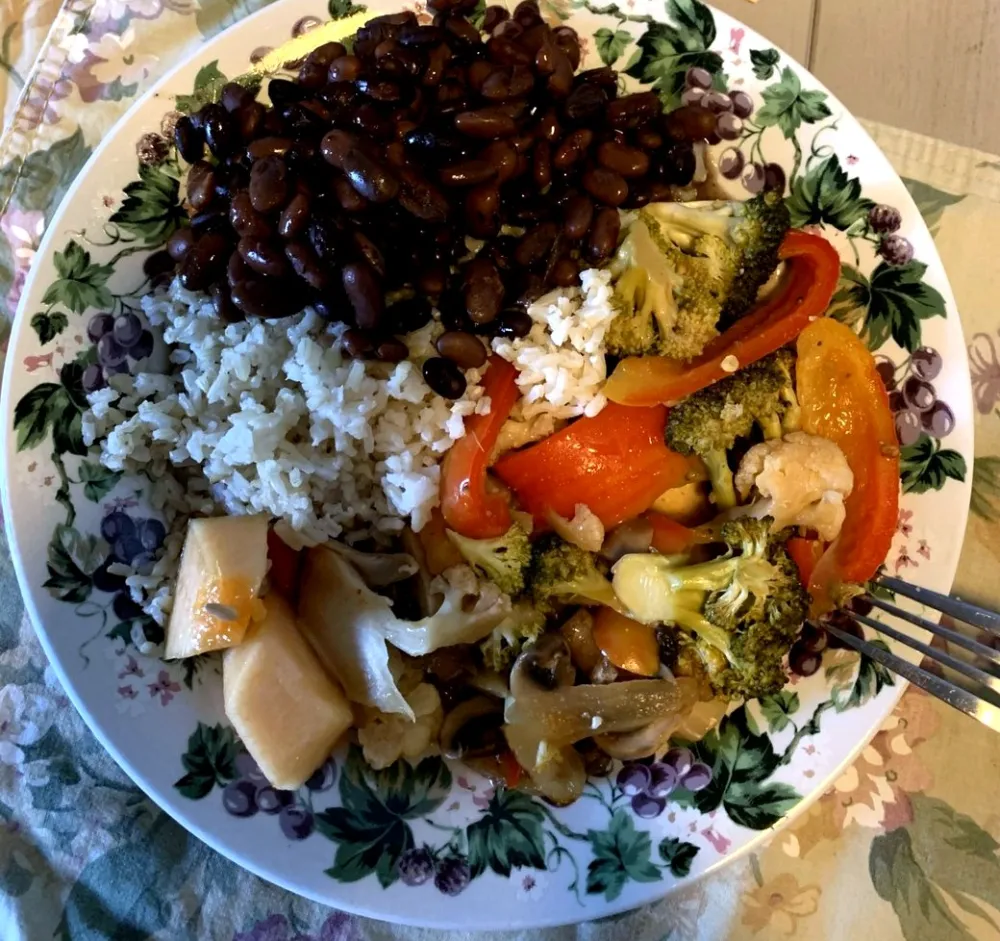
How I eat
Growing up in Puerto Rico, our meals were simple but nourishing: rice, beans, boiled plantains, yuca, and other fresh local foods. Meat was there, but it wasn't the center. Beans were always my favorite. But over time, things changed. More and more processed foods made their way into our pantries. Fast food became easier to access than home-cooked meals. And slowly, our health as a community began to suffer.
I saw it happen in my own life too.
When I left the island for med school, things got worse. I was studying late into the night, eating whatever I could grab quickly: fast food, canned meals, snack bars. It caught up to me. I developed chronic gastritis that left me in constant pain. I couldn't sleep, I couldn't focus, and I felt like I was falling apart.
That's when I started to make small changes.
First, I cut back on red meat. Then chicken. I started eating more fish, and eventually shifted toward whole, plant-based meals. I wasn't following a trend. I just wanted to feel better.
And I did! My digestion improved. I slept better. I felt sharper in school. Step by step, my body healed.

Today, I still eat the foods I grew up with, but in a way that supports my health. I make beans without pork. I boil instead of fry. I use sofrito and other fresh herbs for flavor. I've learned that we don't have to give up our cultural dishes. We just need to prepare them with care. Reclaiming those roots, with intention, has been one of the most powerful parts of my wellness journey.
This is my way of eating, and it works for me and for my family. But it isn't the only way to eat well. Your way may look different… maybe it includes fish, or eggs, or a little chicken in the sancocho. That's okay. What matters is the foundation underneath.
Finding your way
Health isn't about perfection, it's about making progress.
Eating well for you may not look like eating well for me, or for your cousin, or for the person in that video… and that's okay, as long as the foundation is there. Mostly whole plants. Not much ultra-processed food. And a way of eating you can enjoy, not just survive.
Your diet is your way of life. Make it one you love.
Coming up next in Back to the Plate
Now that we've looked at the whole plate from a distance, it's time to zoom in. Over the next few posts, we'll look at what each part of your plate does for you… starting in two weeks with carbohydrates, and the one nutrient almost nobody gets enough of.
The best way to catch every post in the series is to join our newsletter. You'll get each new post in your inbox, plus the recipes, myth-busts, and little check-ins we share in between.
Warmly,
Dr. Giomarell